Suricata
Network-event detection.
STUDENT INNOVATION PROJECT · ACTIVE PROTOTYPE
SentinelBox is designed to turn scattered network-security events into persistent device risk, explain why the risk changed, and apply a bounded, reversible response at the local network edge.
INNOVATION CLAIM
“SentinelBox is designed to combine multiple Suricata events into a persistent risk score for each device. It will explain why the score changed, then apply only the reversible policy allowed for that risk state.”
PROJECT DESCRIPTION
SentinelBox is a local-first network-defense appliance intended for small organizations with roughly 5–100 endpoints. A repurposed Dell OptiPlex Micro running Debian sits inline between the internet connection and the protected network.
The planned detection-to-response workflow uses Suricata to detect network behavior and a Go decision engine to correlate evidence by device, maintain risk in SQLite, map the result to an explicit policy state, and use nftables for reversible enforcement. Gravwell Community Edition is planned for local event investigation.
This is an academic prototype—not an enterprise SIEM, EDR platform, firewall replacement, managed cloud service, or production security guarantee.
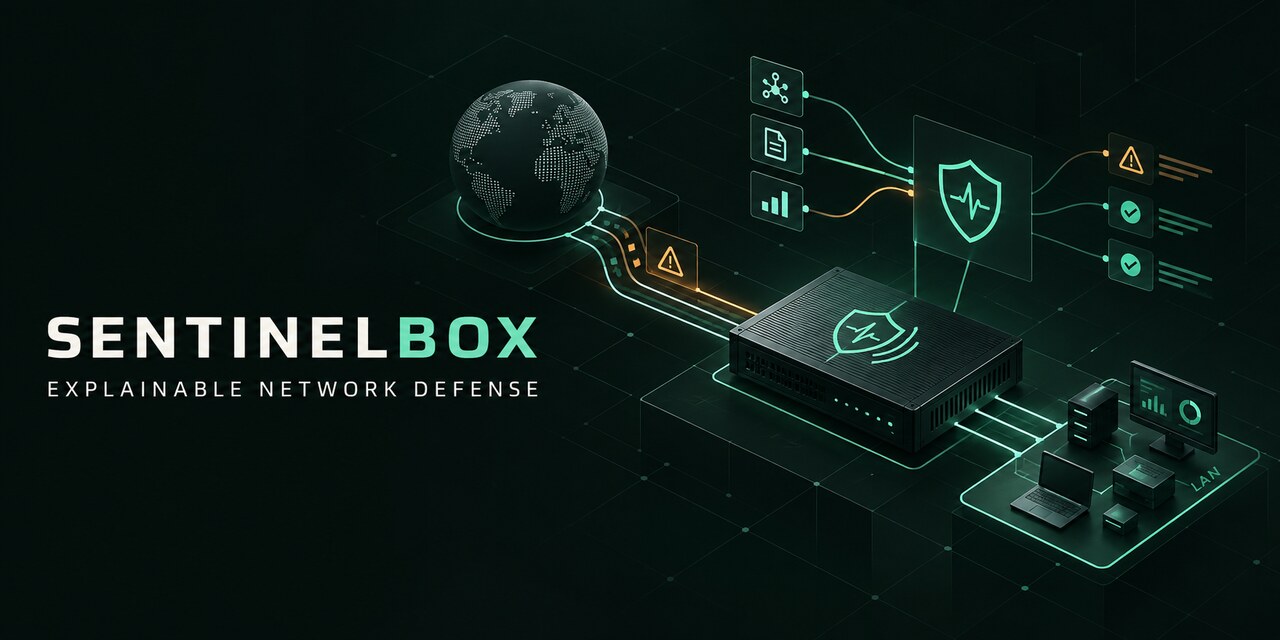
BLUEPRINT / SYSTEM TOPOLOGY
Network-event detection.
Correlation, risk, and audit state.
Local event search.
Reversible network controls.
PROJECT WORK
Source code, architecture, milestone records, and recovery documentation are available below. Updated October 13, 2026.
Visual model of WAN observation, risk processing, and protected LAN response.
The core explainable path from raw event to a bounded action.
Review the source code and project documentation at github.com/TBG-Chance/SentinelBox.
Milestone 1: project foundation ↗
Milestone 2: routed-network software and acceptance checklist ↗
Technical architecture and boundaries ↗
Physical appliance acceptance and the end-to-end detection-to-response demonstration remain pending.
PROOF OF CONCEPT
SIP ROADMAP
Requirements, threat model, architecture, and test plan.
Routed appliance, Suricata ingestion, inventory, and persistent events.
Correlation, risk decay, policy states, and administrator override.
Dashboard, containment tests, performance evidence, and showcase demo.
SME FEEDBACK
The SME requested clearer security functions and a stronger explanation of how SentinelBox differs from existing security appliances. The proposed functions are network-event detection, device-centered correlation, persistent risk with decay, an explanation of each score change, and policy-limited reversible response.
The innovation focus is the traceable chain from several observations to a device-risk decision and a reversible action on a modest local appliance. Suricata supplies established IDS capabilities; SentinelBox’s proposed contribution is the decision layer around those events. A firewall controls traffic, Pi-hole focuses on DNS filtering, and Wazuh provides broader security monitoring. The project does not claim that these tools lack overlapping capabilities.
The planned demonstration will show linked events, a risk-score change, the permitted response, and administrator release. Controls apply to traffic crossing the gateway; devices communicating directly on the same downstream subnet may bypass it.